
Interior Design Trends 2027 and the Ones Already on Their Way Out
Every trend list says the same three things. Earth tones. Curved sofas. Bring the outside in. Fine if you're writing a magazine spread. Not much help if you're standing in your living room trying to work out whether that boucle armchair is going to look stupid in eighteen months.
So I've done this one a bit differently. I've split the interior design trends for 2027 into the ones picking up speed and the ones that peaked in 2025 and are quietly on their way out. And for each one there's a way to test it on a photo of your real room, so you're comparing instead of guessing.
Short version
2027 is warmer, rougher and more personal than the flat greige minimalism we've been stuck in since about 2020. More colour. More visible material. More evidence that somebody lives there. The pendulum is swinging away from showroom perfect and it's been swinging for a while now.
1. Warm minimalism is eating cold minimalism
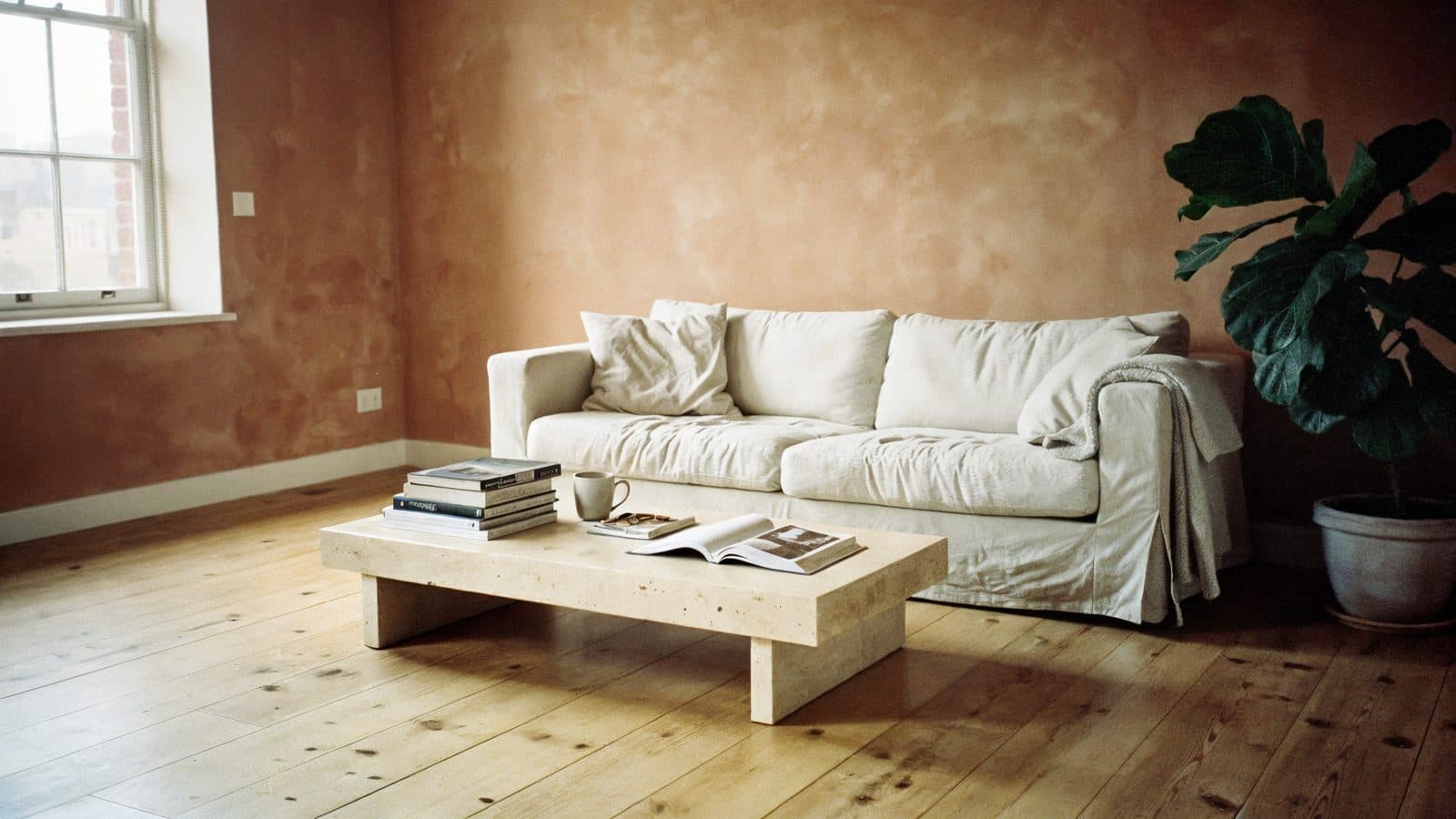
Minimalism isn't going anywhere. The white box version of it is. What's replacing it keeps the restraint and drops the chill: plaster and limewash instead of flat matte paint, oak and walnut instead of high gloss white, wool and linen instead of whatever that polyester weave was.
For a room that already exists, this trend is almost entirely about surface and light. Not furniture. Taking a wall from flat white to a warm limewash and swapping your cool white bulbs for 2700K will move a room further towards 2027 than a new sofa will, and it costs about a tenth as much.
Want to see it first? Upload a photo to Interior AI and ask for the same layout in a warm minimalist palette. It holds your room's geometry and only reworks the materials and the light, so what you get back is your room, not a catalogue room.
2. Colour drenching, but calmer
Colour drenching, where walls, trim, ceiling and sometimes the joinery all get the same colour, was the loud trend of 2025. It hasn't gone away. It's just grown up. The 2027 version uses muted, dusty, slightly muddy colours instead of jewel tones. Clay. Olive. Mushroom. A deep slate blue that's almost grey but not quite.
The reason it keeps working isn't fashion, it's geometry. Drenching kills the visual break between wall and trim, so a small room reads as one continuous volume instead of a box with lines drawn on it. It's the cheapest trick there is for making a cramped bedroom feel bigger.
| Room | Colour that'll age well | Colour that'll date fast |
|---|---|---|
| Small bedroom | Dusty clay, mushroom | Bright teal |
| Home office | Deep olive, ink blue | Fire engine red |
| Hallway | Warm putty, sand | Neon accent wall |
| Dining room | Oxblood, deep terracotta | Millennial pink |
3. Curves are calming down
The curved everything era is over. Round sofas, arched doorways, bulbous lamps, kidney shaped coffee tables, all of it at once. It hit saturation somewhere around 2024 and now it looks a bit try-hard.
In 2027 curves survive as one or two pieces in a room rather than a whole language. One arched mirror. One rounded armchair. Straight lines for everything else.
This is the trend I'd most strongly recommend testing before you buy, purely because curvy furniture is expensive and almost impossible to resell. Render the room with a curved sofa, render it with a straight one, look at both, pick.
4. Materials you can see
Travertine. Unfilled marble. Burl wood. Hand thrown ceramic. Unlacquered brass that's going to patina and is supposed to. All of it shows its age rather than hiding it, which is the exact opposite of what everyone wanted in the 2010s.
If you're renovating rather than redecorating, this is the one with the longest tail. Material choices outlive paint colours by about a decade.
5. The unstyled room
Bookshelves with actual books on them. Dining chairs that don't match. Art hung slightly too low. A plant that's honestly too big for the corner it's in.
After ten years of interiors designed to photograph well, 2027 interiors are designed to live in. Buy fewer matching sets. Keep the furniture you inherited even though it doesn't go. Let one weird object dominate the room.
6. AI stopped being a gimmick
This is the quiet one, and it's the reason the other five are easier to act on than they were three years ago.
I pulled Google Trends data for the twelve months to the end of August 2026. Put on one normalised scale, worldwide search interest looks like this:
| Search term | Average interest, 12 months | Peak week |
|---|---|---|
| interior ai | 67 | Early March 2026 |
| ai home design | 24 | Early May 2026 |
| exterior ai | 22 | Mid April 2026 |
| ai floor plan | 13 | Early May 2026 |
| virtual staging | 3 | Flat all year |
Two things jump out. "Interior AI" beats every other way of phrasing it by roughly three to one, which means people have stopped searching for "AI interior design software" and started searching for the category by name. That's what happens when something becomes normal. And the whole category is very seasonal. Interest starts climbing in January, peaks between March and May, and falls off a cliff in August.
The behaviour change matters more than the numbers though. Three years ago these tools gave you a nice picture of a room. Now they hold your room's geometry, your window positions and your proportions still, and change only the thing you asked them to change. Inspiration became a decision tool somewhere in there. You can find out whether something works in your room before you spend money on it.
How to test all six on your own room this afternoon
Take one photo per room. Shoot from a corner, in daylight, with the whole floor in frame. Photo quality matters more than anything else you'll do here, so don't shoot at night.
Then upload it to Interior AI and generate the room in two or three of the palettes above, keeping the layout fixed. You want to be comparing finishes, not furniture.
If the room is cluttered, strip it first. Remove Furniture AI empties the space so you're judging the shell, the walls, the light, the proportions, instead of reacting to the sofa you already own and already have opinions about.
Compare them side by side rather than one after another. Trends all look appealing in isolation. The differences only become obvious next to each other.
And print the two you like most. Screens flatter saturated colour in a way paper doesn't, and you're going to live with the paper version.
If you're working from a drawing rather than a finished room, Sketch AI takes a hand sketch straight to a photorealistic render instead.
What's on the way out
Dodging a dying trend saves you more money than catching a new one, so:
All grey everything. Done. Grey with nothing warm next to it reads as 2016 now.
Open kitchen shelving. Looks great in photos, collects dust in life. Being replaced by closed cabinetry with one short open run for the nice bowls.
Fast fashion furniture in trend colours, for the obvious reason. The direction of travel here is longevity.
Barn doors. They were never good at the job.
And matching bedroom sets, for the reason in section five.
Common questions
What's the biggest interior design trend for 2027?
Warm minimalism. Restrained layouts, but with warm textural materials like limewash, oak and wool. It's a correction to the cold white minimalism of the last decade rather than a replacement for minimalism itself.
Which colours are trending in 2027?
Muted and slightly muddy rather than saturated. Clay, mushroom, olive, warm putty, deep slate blue, oxblood. Usually applied as full room colour drenching rather than a single accent wall.
Is grey out of style in 2027?
Grey as a whole room scheme, yes. Grey as a supporting neutral next to warm wood and textile is fine and will stay fine. Grey was never really the problem. Grey with nothing warm to balance it was.
Will AI show me these trends in my own room?
It will, and that is new in the last two years or so. Current interior AI tools keep your walls, windows and proportions and restyle only the surfaces and furnishings, so what comes back is your room in a different palette instead of a generic render. One decent photo gets you usable comparisons in seconds.
When should I start planning a 2027 renovation?
Autumn or winter. Search demand peaks between March and May, and contractor demand peaks right alongside it. If you plan between September and January you're booking trades before everyone else wakes up.
Five words
Warmer, rougher, more personal, less perfect.
Nearly all of it is reachable through surface, light and colour rather than a full renovation. That is the reason it is worth testing on a photo first: the changes are cheap enough that the deciding costs more than the doing.
Start with one room, one photo and two palettes. Try Interior AI free and see which version of 2027 suits the room you're sitting in.
Related reading