
Living Room Ideas for 2027 That Survive Contact With a Real Room
There is a rhythm to this that nobody mentions. Interest in living room ideas sits at almost zero through autumn, wakes up in the first week of January, and peaks in the second week of March. Then it falls away for the summer.
I pulled the twelve months to the end of August 2026 and the curve for living room ideas 2026 is unambiguous: 0 to 1 through September and October, 5 by early January, 11 at its March peak, back to 2 by August.
Which means the useful time to think about this is now, in the quiet part, and the useful thing to think about is which ideas will still look right in eighteen months rather than which ones are loudest this week.
Nine ideas, sorted by how long they last
The ones with a long life
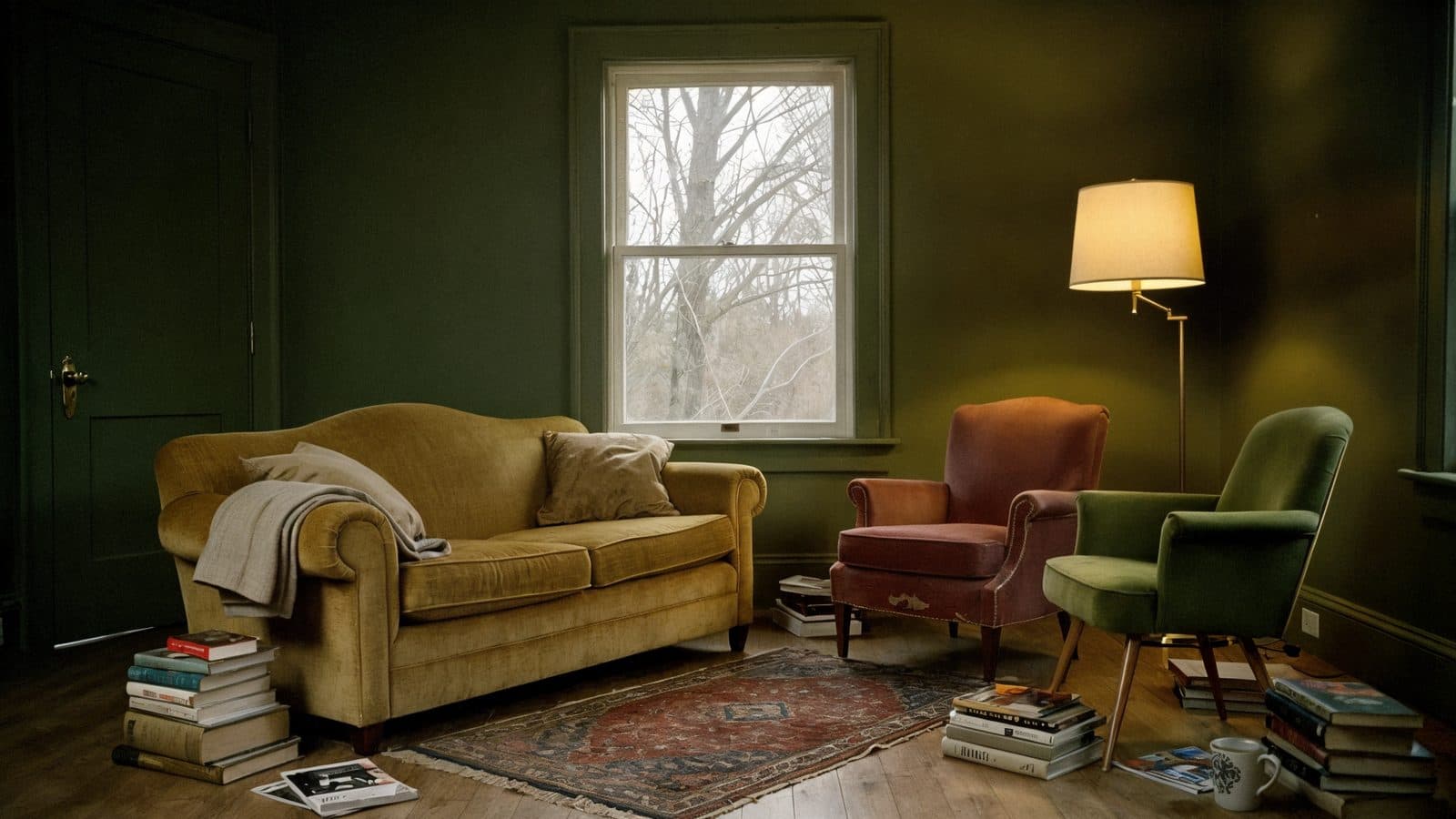
Colour on every surface. Walls, trim and ceiling in one muted tone. It works for a structural reason rather than a fashionable one: removing the break between wall and trim makes a small room read as a single volume instead of a box with lines drawn on it. Clay, mushroom, deep olive and a slate blue that is almost grey all age well. Bright teal does not.
Warm materials over cold ones. Limewash instead of flat matte. Oak instead of high gloss. Wool and linen instead of synthetic weave. This is the single biggest shift of the last three years and it is nowhere near finished.
One curve, not nine. The curved-everything phase peaked around 2024 and now reads as try-hard. An arched mirror or one rounded armchair against straight lines still looks considered.
Lighting at three heights. Ceiling, mid, floor. Almost nobody does this and it changes a room more than furniture does. A single overhead fitting flattens everything under it.
Books, plants and things that are yours. The unstyled room is the direction of travel. Mismatched chairs, art hung slightly low, a plant that is honestly too big. After a decade of rooms designed to photograph well, 2027 rooms are designed to sit in.
The ones with a shorter life
Full colour drenching in a saturated tone. The muted version lasts. The jewel-tone version is a 2025 photograph.
Statement bouclé. Beautiful, expensive, and impossible to resell. If you want it, want it in something small.
Open shelving as the main storage. Photographs well, collects dust, gets abandoned. Closed cabinetry with one short open run is where people land after living with it.
Matching three-piece suites. Still on sale everywhere, still the fastest way to make a room look like a showroom floor.
The part where most of this goes wrong
Every one of those ideas is fine in the abstract and half of them will be wrong in your particular room.
A sofa that anchors a nine metre living room is furniture-shop overflow in a four metre one, and the photograph you saved will not tell you which room you were looking at. Half of what you liked in that photograph was the light, and light belongs to the building rather than to the decor. A north-facing room in northern Europe does not do what a Los Angeles living room does at four in the afternoon, whatever you put in it.
So the sequence that works is not "collect ideas, then buy". It is "collect ideas, test them against this room, then buy".
Testing them properly takes about twenty minutes
Photograph the room from a corner, in daylight, with the whole floor in frame. Corners give the tool two walls and a floor to read the volume from. Overcast is better than sunny, because hard shadows confuse the render.
Upload it to Interior AI and change one thing at a time. Wall colour first, because it is the cheapest thing to change and the biggest thing to see. Keep the layout fixed so you are comparing finishes rather than furniture.
If the room is cluttered enough that you cannot judge the shell, empty it first with Remove Furniture AI. Judging a bare room is a different exercise and usually a more honest one, because you stop reacting to the sofa you already own and already have opinions about.
Then put the finalists side by side rather than flicking between them. Everything looks appealing on its own; differences only appear next to each other.
And print the two you like most. Screens flatter saturated colour in a way paper does not, and you are going to live with the paper version.
If the room is small
Small rooms punish the wrong decision harder, so the order of operations changes.
Deal with the walls before the furniture. Colour on every surface is the cheapest way to make a small room feel bigger, and it costs a weekend.
Then buy fewer, larger pieces. Several small items make a small room look cluttered; one properly sized sofa makes it look intentional. This is counterintuitive enough that seeing it rendered is worth more than being told it.
Keep at least 90 centimetres for the main walking route through the room. If a render looks great but breaks that, the render is wrong and the number is right.
Common questions
What living room colours are coming in 2027?
Muted and slightly muddy rather than saturated: clay, mushroom, olive, warm putty, deep slate blue, oxblood. Usually applied across walls, trim and ceiling together rather than as a single accent wall.
Is grey finished?
As a whole-room scheme, yes. Grey as a supporting neutral alongside warm wood and textile is fine and will stay fine. Grey was never the problem; grey with nothing warm to balance it was.
When should I start planning a living room refresh?
Autumn or winter. Search demand peaks in March and contractor demand peaks with it, so anything needing a trade should be booked between September and January.
How do I know an idea will work in my room?
Test it on a photograph of that room before buying anything. Current tools hold your walls, windows and proportions steady and change only the finishes, so what comes back is your room in a different scheme rather than somebody else's room.
What is the cheapest change with the biggest effect?
Paint, then lighting. Taking walls, trim and ceiling to one warm tone and swapping cool-white bulbs for 2700K will move a room further than a new sofa will, at roughly a tenth of the cost.
Do I need to follow trends at all?
No, and the ones worth following are the ones that were already true. Warm materials, layered light and rooms that show evidence of a person are not really trends. They are just what makes a room comfortable, arriving back in fashion.
Start with the wall
One photograph, one wall colour, two options.
That single test settles more than any amount of scrolling, and it takes about as long as making a cup of tea. Try it on your living room.
Related reading